

In the case of hardware problems of all kinds, Windows’s first point of contact is the first point of contact. It offers many more opportunities than opening at the beginning. In this small article we provide help to characteristics and possibilities, to identify unknown hardware or to prevent a change of driver (10).
Family image
The Windows devices manager is one of the few Windows areas that has not changed over the years. It also seems even safer under Windows 10. The device manager is therefore the first point of contact for problems with hardware.
Depending on the version of Windows, the device manager can be recalled in various points, but it can always be found under the system in the control panel. However, it can also be started in Windows 10 using the Win+X key combination in the menu that appears or by starting «Perform» Devmgmt.msc «.
After the beginning, the device manager lists all devices in a construction view, grouped according to «groups of devices», so groups can also be opened.
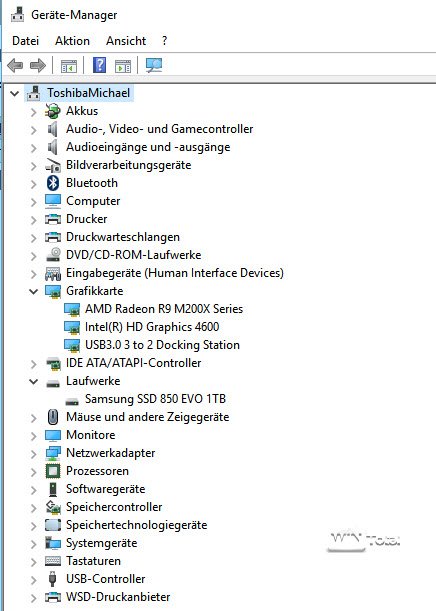
The view can also be ordered via the menu item with the same name via connection or resources.

If you have hidden a device because it has been recognized as an unknown, for example, you can view «View».
In addition, the device manager can also use a batch file with the controls
set devmgr_show_nonpresent_devices=1

start devmgmt.msc
be started. So the device manager also indicates those who are currently not connected to «hidden devices», e.g. Old USB sticks or no more existing printer.
The marked device is not connected to the following screen, but now it is displayed.

Actions
The device manager offers several actions that hide behind the menu item. «Find Hardware» starts a new search for plug-and-play devices, but it should actually take place automatically when infected. The action is required if a device has been removed via the device manager and you want Windows to recognize it directly. «Legacy Hardware» is still a residue made of old Win9x times, in which the special cards, for example, have not been automatically recognized for the scanner.
If you are under a device, you will find three other options in action: «Update the driver software», «uninstall» and «disable». The latter spends a device. This makes sense, for example, if the device causes problems during operation or is recognized by Windows due to the lack of driver at each system start.
Restore the driver and then prevent it from Windows Update
«Update the driver software», on the other hand, look for more recent drivers on the computer or online.

In automatic research, Windows is looking for drivers suitable for Microsoft, which can take time. However, since Microsoft supports a huge number of devices in the meantime, the chances of success are not so bad, especially in printers.
The alternative way to look for the driver software on the computer allows you to specify a targeted path with the driver files you have loaded from the Internet. Note that drivers must be unveiled. Windows cannot use a packaged file or an installer here. The system depends on a structure as in the screenshot where there is a file file that describes the driver in more detail.

Many devices, in particular printers, want to be connected, especially after installing the installation files, because Windows SA already where the driver files are found for the device (in which Windows System32 Driverstore).
Properties of devices
Let’s go to the devices themselves.

It is possible to view the details of the driver there and perform the functions already known by the «action» «» update driver «,» deactivate «and» uninstall «.
The «previous driver» function, on the other hand, performs a rollback to the previous driver if Windows with the most recent driver has a problem. Windows would like to have a reason for this, since it usually affects the drivers that have been delivered via Windows Update.

This rollback recalls Windows and then installs a new driver for the device when one is offered in a more recent version via Windows Update.
Find drivers for unknown devices
Often, notebooks in particular fall through the Windows grid and indicate numerous unknown devices in the device manager. The good advice is expensive, that the driver can be recorded in detail. A key to the solution is hiding here in the «Details» tab.
For each device, you can use the «property» selection field to determine what should be displayed in the «value» field. Select Hardware ID here.

So see a value behind «ven». This is a key to the manufacturer, which can be questioned via websites such as PCidatabase.com or the PCI ID repository. In our case, the Supplier ID is the producer Advanced Micro Devices, Inc. [AMD/ATI] assigned.
It is also possible to copy the complete item in the first line to the value via the contextual menu in the notes and then search for it on the Internet via Google or in particular on websites such as devid.drp.su. Often find out so that the unknown device «Acti Ven_tos & Dev_620a» is assigned to the HDD shock sensor by Toshiba notebooks. The way for the right driver is therefore only a stone shot through the manufacturer’s homepage.
In addition to device manager, tools such as Aida64, Devmanview, Siv or Hwinfo can help trace unknown devices.
A note: if possible, do not download drivers from unknown sources. It is not sure if this is really the right driver or maybe a malware or the like. Don’t even pay money for drivers. There are many internet providers who are happy to capture drivers through research services and therefore to collect for a download by credit card, Paypal and Co.
Arresting the automatic driver updates from Windows or Cancel
Since we are currently with drivers: from Windows 10, the user, at least the home edition, is almost a choice of updates to its system. We summarized the topic separately in an article «Updates and updates under Windows 10 under control».
It is possible to prevent only driver updates by interfering with the directive of the register or group (PRO).

Only the update of the creators (1703) offers an option to exclude drivers from the update of Windows, which are hidden behind the extensive options in the Windows Update settings.

Conclusion
The device manager remains the heart around the hardware also with Windows 10. All Windows users should know his possibilities.

 (49 votes, media: 4.30 out of 5)
 Loading …
latest posts published
Our complete stabilizer test

The best memory supports for Android and iPhone

Convert and edit audio files

Code publishers: you should know these programming tools
XP mode in Windows 8 with VMLite
How problematic are smartphones for the environment?

Make a period of time with a GoPro: how to do it?

The best round -based strategy games for the PC

Pay to Vince: the monetization of video games