

After several weeks of testing with this new camera, we were very affected by many of its updates.
Our rapid verdict:
Pour:
Extreme slowdown in the video to 240 images per second
Impact image stabilization
Significantly higher Wi-Fi transfer speed
Against :
You still have to show patience to use it
The different checks can be complex
An expensive gadget for the use of the type of hobby
Gopro launched his new flagship camera, The Hero6, last September, with some new important features that make him an intelligent update for all those who frequently frequent film sport.

Gopro Hero6 Black Action Chamber
- Video: 4K60 / 2.7k120 / 1440p120 / 1080p240 and more
- Advanced video stabilization
- Capture photos in raw and HDR formats
- Robust and waterproof up to 10 m without box
The most remarkable element is to improve the stabilization of the video, which eliminates the need for a gimbal. Gopro also made significant resolution changes: Hero6 (unlike Hero5) capturing images in 4 k at 60 frames per second and images in 1080p at 240 frames per second. Finally, thanks to a more powerful Wi-Fi signal, Hero6 has a better integration for applications and works with the new Quiikstorias function, which allows you to get video sequences automatically mounted.
I managed to get one of these cameras when it was launched and since then I have been able to test it. I took it to Mountain Bike, Kart and excursions for four days. I also played at home. Overall, I was very impressed by the progress that Gopro made between 5 and 6. Here are the reasons.
Internal stabilization
In my opinion, a better image stabilization is the most important update that has been on Hero6, the most exciting, which allows to obtain fluid and fluid images without additional equipment, such as a gimbal.
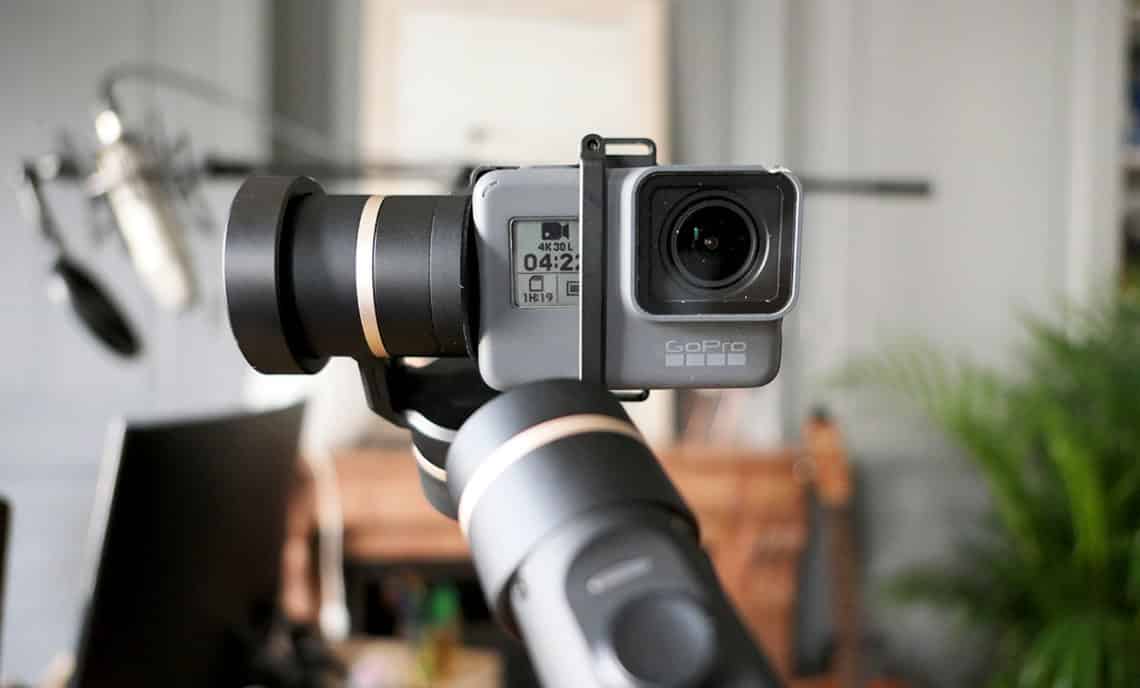
First I had to mount my GoPro on a stabilizer, such as Gopro’s Karma Gip, to reduce the tremors present during filming. With the 6, unlike before, simply activates the internal stabilization function of the image on the touchscreen, and that’s it: I can film a mountain bike in the mountains without having the desire to vomit when I watch what I filmed.
Of course, Hero5 also had an internal stabilization, but was active only on two axes. In the same way, stabilization worked only when you took a photo with a narrow or medium vision field (which actually corresponds to the width of the field for which the camera is configured). The hero6, on the other hand, has three axes which is available in a larger range of resolutions and images (such as 4K at 30 fps and 1080p at 120 fps), included for a large visual field.
Is Hero6 stabilization the same as SteaDicam’s professional level? Absolutely not. But it is a great improvement compared to Hero5 and this helps you to create considerably videos with a more professional rendering.
To test stabilization, I took a black hero, which therefore has no stabilization, and I faced it with the black hero who had the stabilization activated. I made a bicycle tour in local routes near our headquarters in Santa Fe. The two cameras were mounted on my handlebar and recorded in 1080p at 60 frames per second in Superiew mode, which gives you the largest viewing field and is ideal for POP.
https://www.youtube.com/watch?v=faksbn2u-k8
Here is another clip of the bike ride in the mountain captured at another time. It was shot in 2.7 k at 60 frames per second with an activated internal stabilization. (The 2.7K option at 60 FPS is one of my favorites, because a higher resolution is obtained than HD and a quick image rate, which is good for sport, while enjoying internal stabilization.)
https://www.youtube.com/watch?v=qrgrwptzqgc
Finally, here is finally a clip taken from 4 k to 30 frames per second with the stabilization activated (unfortunately we cannot obtain stabilization in 4 k at 60 fps). So I continue my friend on foot as I pedal.
https://www.youtube.com/watch?v=yykbmlorzyk
Capture slow motion
Ok, stabilization is the key update of this camera, but I was also quite enthusiastic about improvements such as the video in 1080p at 240 frames per second, which allows you to create ultra-pave sequences that are ideal for capturing images of different sports.
The iPhone 8 can capture the same type of inactive, but the GoPro always has an advantage of mobility and ergonomics: it is much easier to attach to your bike, the ski helmet or your dog. In addition, I worry less about the sustainability of a $ 500 GoPro of a fragile iPhone to $ 1,000.
Here is an extract from my dogs that runs in the garden to 240 images per second:
https://www.youtube.com/watch?v=2u3gfkg5u–
And here is an extract by my friend who fishing the fly, and also a bonfire captured in 1080p at 240 fps:
https://www.youtube.com/watch?v=wyg1njragpo
Having said that, you will have to use the function of the frame 240 per second in moderation, since it is destined to capture sporting moments.
I found myself more often in 2.7 k at 120 fps because I like a higher resolution and because 120 fps is more than enough. I also use the 1080p mode at 120 fps, because it allows internal stabilization (unlike 1080 p at 240 or 2.7k to 120). Here is an example from 1080 from P to 120 with activated stabilization:
https://www.youtube.com/watch?v=-12rnvjd3de
Video-revolution of high resolution to 60 images per second
For fans of videos like me, this fastest image frequency is really a great update, as it is more effective in capturing high resolution moments. But most of the time, it is actually too much for most people: the files are too big.
If you transfer the clips from Hero6 to your phone, then download on Instagram or Facebook, these clips will be compressed at a lower resolution: 720 p or 1080 p. If you intend to change your images with the first pros or final cut, then yes, the 4K images reduced to 1080 P will be really beautiful. But how many people will notice on Instagram? Especially for most users, the 4 K shot occupies much more storage space on your memory card (and your computer) than 1080 %.
During the launch of Hero6 in San Francisco, we made Kart and roll in electric bike throughout the city. I asked a Gopro technician what his favorite way was to go around for the activities of the day. He told me that the 1080p at 60 images per second in Superiew with stabilization activated was his basic setting for almost everything. He likes this configuration because he is superb, which seems good for your phone and allows the battery to last longer. (Hero6 is supplied for 70 minutes of use in 4 k at 60 against 100 minutes in 1080p at 60.)
As an indication, here are some clips shot from 4 k to 60:
https://www.youtube.com/watch?v=FDVVAWLVSBQ
https://www.youtube.com/watch?v=zipyjbw6s8q
These clips are superb, but what you need to get here is that you will have to choose the right resolution, the frequency of the image and the right display for any situation. If you only shoot for Instagram, do not approach you at 4 k. If you turn for a real movie, try it. It can be difficult to always choose the right combination, but fortunately for us Gopro has a guide to get the most out of your camera based on what films.
The GoPro application
The power of the GoPro can extend when it is connected to the application and this integration has simply improved significantly.
First of all, it is much easier to combine your Hero6 with the application thanks to a new owner processor that makes the Wi-Fi signal three times faster. The twinning process is not even perfect – I still had some problems and the application has also frozen – but this is much better than before.
The other important development is called Quiksstories. It is an integrated assembly program that automatically uses faces, GPS and audio to identify the best clips, therefore it adapts them to assembly.
As a professional video editor, I was skeptical about QuickStories. But now that I saw him at work, I am impressed. I capture a large part of those that I would consider the highlights, then the cuts together in a concise assembly, easy to look at and regular on an audio track of your choice. You don’t need to spend time climbing if you don’t want.
But it is not perfect and often there is no key scenes. To facilitate assembly, it is possible to capture shorter moments (to analyze it faster) and highlight the clips you consider important. (You can do it using the vocal message of the camera saying «Gopro Highlight»)
Here is an example of what it can do with very little help for Cameraman:
https://www.youtube.com/watch?v=3r_z5ayjd4
Vocal control
Gopro introduced the voice command with Hero5, but improves with Hero6. Being able to stop and start recording, switch from photographic mode to video mode and turn off the camera without ever touching it, it is extremely useful when skiing or bicycle in the mountains and you have to focus on what you do.

Photo
Hero6 is first of all a video camera, but it also captures beautiful shots: the camera is the same as that of 5 and produces JPEG files or 12 megapixels.
Is the camera better than what is in the new iPhones? No. But once again, the GoPro is ideal for obtaining corners that your phone fights to capture, if you take into account all the different places you can climb.
Should you disturb yourself?
I used the Hero4 Black and Silver models from their launch in 2014 and I have never heard the need to go to Hero5, the greatest improvements were waterproof without the case, the voice command and the stabilization in two axes. In my opinion, none of these characteristics agreed to provide an extraordinarily better device.
With Hero6, however, I get the best from Hero5, as well as improved stabilization, better quality images and better integration for the application. This therefore became an obvious update for all those who have a hero4. If you have Hero5, you will still benefit from a more fluid and better quality video, as well as a easier to use mobile application.
One last observation: if you save money to buy a POV camera, you should also think about the new Fusion camera, the 360 degree camera of GoPro delivered in December. I am not a big fan of 360 degrees images, but I can’t wait to see how a device will work called Overcapure. It is said that it is possible to film a spherical and complete video, therefore, after the fact, choose a corner and read it like a normal POV video with a fixed perspective.
latest posts published
Our complete stabilizer test
The best memory supports for Android and iPhone

Convert and edit audio files

Code publishers: you should know these programming tools
XP mode in Windows 8 with VMLite

How problematic are smartphones for the environment?
Make a period of time with a GoPro: how to do it?

The best round -based strategy games for the PC

Pay to Vince: the monetization of video games